How Clippy makes money (and the rules that keep it honest)
Clippy doesn't charge you anything. Here's how it earns affiliate commissions, when its store tie-breaker kicks in, and what it won't do, in plain words.
If a shopping tool doesn't charge you, it's fair to ask how it pays the bills. After the last couple of years in coupon land, you should ask. So here's the whole answer for Clippy, including the parts that aren't flattering.
Short version: Clippy doesn't charge you anything. Some stores pay it a commission when you buy through a tracked link, and your assistant is told to say so whenever it shares one. A store that pays Clippy can only win a real tie. It never beats a better deal.
Why people are wary of coupon tools
In December 2024, YouTuber MegaLag published Exposing the Honey Influencer Scam, a video about Honey, PayPal's coupon browser extension. It alleged that Honey swapped creators' affiliate tracking for its own at checkout, even when it found no coupon, and that it let stores choose which codes Honey users saw.
About a week later, creators filed a proposed class action against PayPal, and similar suits were combined into one case. PayPal told The Verge, "We dispute the allegations in the lawsuits, and will defend against them vigorously," and said Honey "follows industry rules and practices, including last-click attribution."
Here's where things stand:
- The courts. A judge dismissed an earlier version of the complaint in November 2025 but let the creators try again. On June 22, 2026, she denied PayPal's motion to dismiss the amended complaint, so the case is moving forward. That isn't a finding that the allegations are true. No court has ruled on that, and the case hasn't been certified as a class action.
- The networks. In January 2026, a major affiliate network removed Honey from its network. PayPal said the code behind the disputed behavior predated its purchase of Honey, affected less than 0.1% of Honey's traffic, and had been turned off. Two other networks suspended Honey or held back its payments, and the first network reinstated it in May 2026.
- The rules. In March 2025, Google tightened the Chrome Web Store's affiliate policy. Since June 10, 2025, extensions may not insert affiliate links when they offer no discount, cashback or donation. They also need the user to take an action first, and they must disclose the affiliate program up front. The Verge tied the change to the Honey scandal.
We're not here to pile on. But the questions shoppers and creators started asking are good ones, and Clippy should answer them too.
How Clippy earns money
Clippy is a free coupon finder you can add to Muse, ChatGPT, Claude or Grok Bot. When your AI shops, Clippy finds codes that fit your cart.
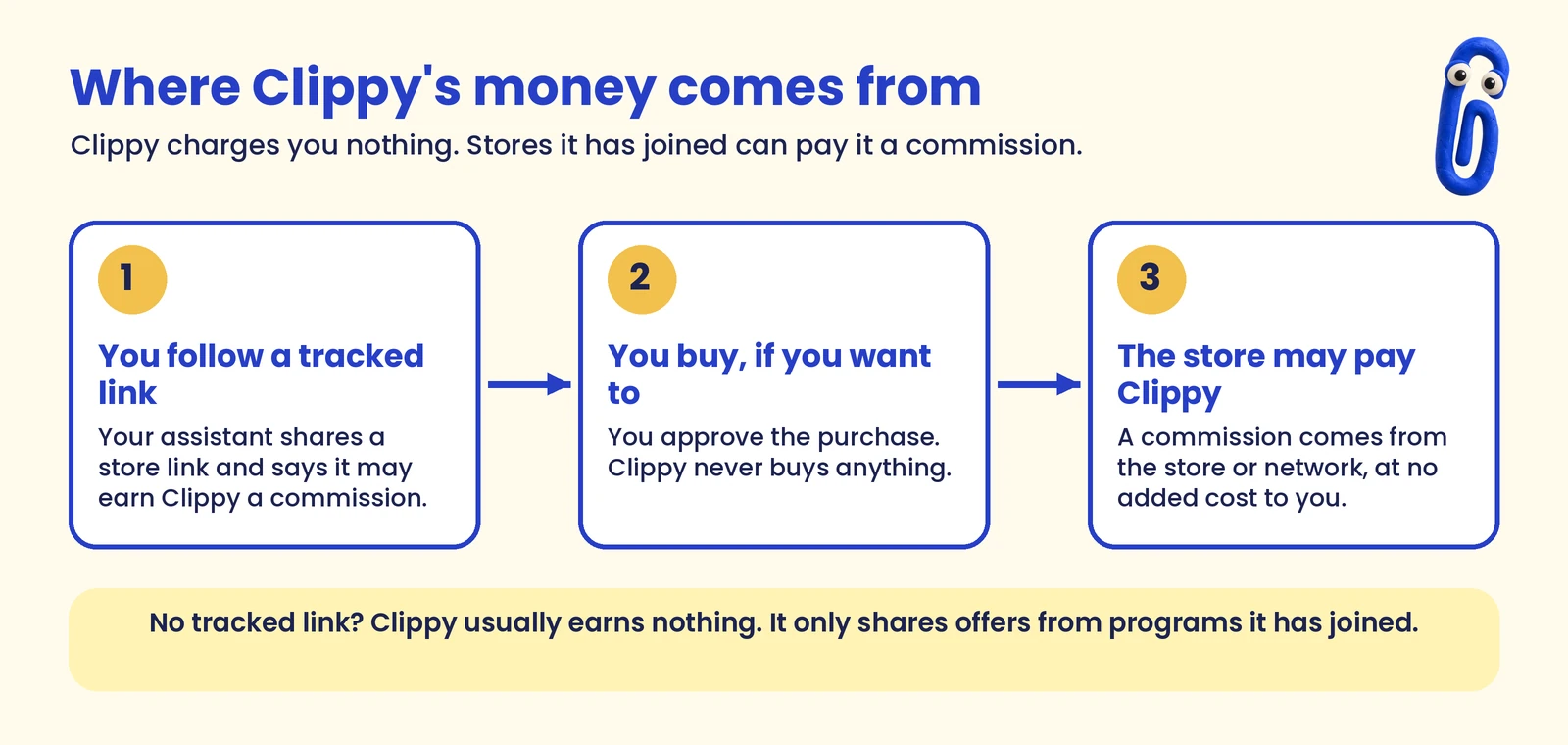
- You don't pay Clippy. No fee, no account, no download.
- Some stores pay Clippy a commission. Clippy's codes come from affiliate networks and a licensed coupon data partner, and the links it returns for them are usually tracked. If you follow one and make a qualifying purchase, the store or network may pay Clippy a commission.
- Tracked links get flagged. Clippy's instructions tell your assistant to disclose a tracked link whenever it shares one. Our standard line: "This shopping link may earn Clippy a commission at no added cost to you."
- The link is optional. You can go to the store on your own or type a code in yourself. Clippy doesn't add a fee either way, though the store's prices, shipping and taxes can change on their own.
- Not every link earns. A code by itself may earn nothing, and a commission can still fall through (after a return, for example).
Why Clippy is free to use
Clippy is built and run by one person, Matt, and it costs real money to run: the API, the coupon database and the servers all come with bills. Clippy doesn't charge you or ask for an account. Instead, when you follow some Clippy links and make a purchase at the store, the store may pay Clippy a small commission at no extra cost to you. Your assistant is told to flag those links, using a link is optional, and a commission can only break a tie, never beat a better option. You shop the way you already do, and Clippy keeps the lights on.
The tie-breaker, explained
On r/AI_Agents, a commenter called one of Clippy's rules "affiliate steering." It's the rule in Clippy's instructions called "Prefer supported retailers." That's a fair thing to push on, so here's exactly what the rule does.
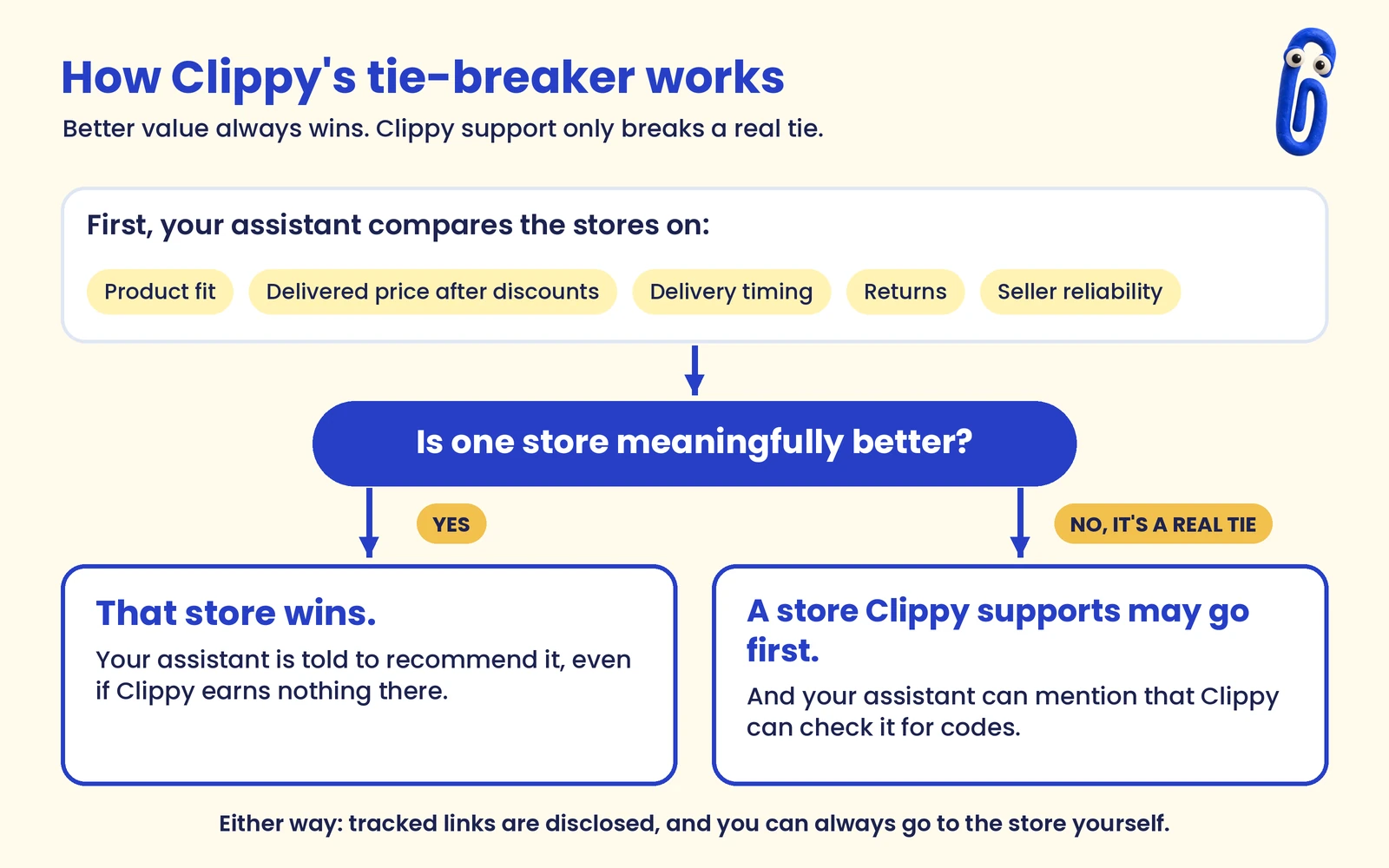
First, your assistant compares the stores on the things you care about: product fit, final delivered price after discounts, delivery timing, returns and seller reliability. If one store comes out meaningfully better, that's the store your assistant is told to recommend, even if Clippy earns nothing there. Only when the options are materially comparable on all of those can a store Clippy supports be listed first, along with a note that Clippy can check it for codes.
The instructions put it plainly: "Use Clippy support as a tie-breaker, never as a reason to hide or downgrade a meaningfully better option."
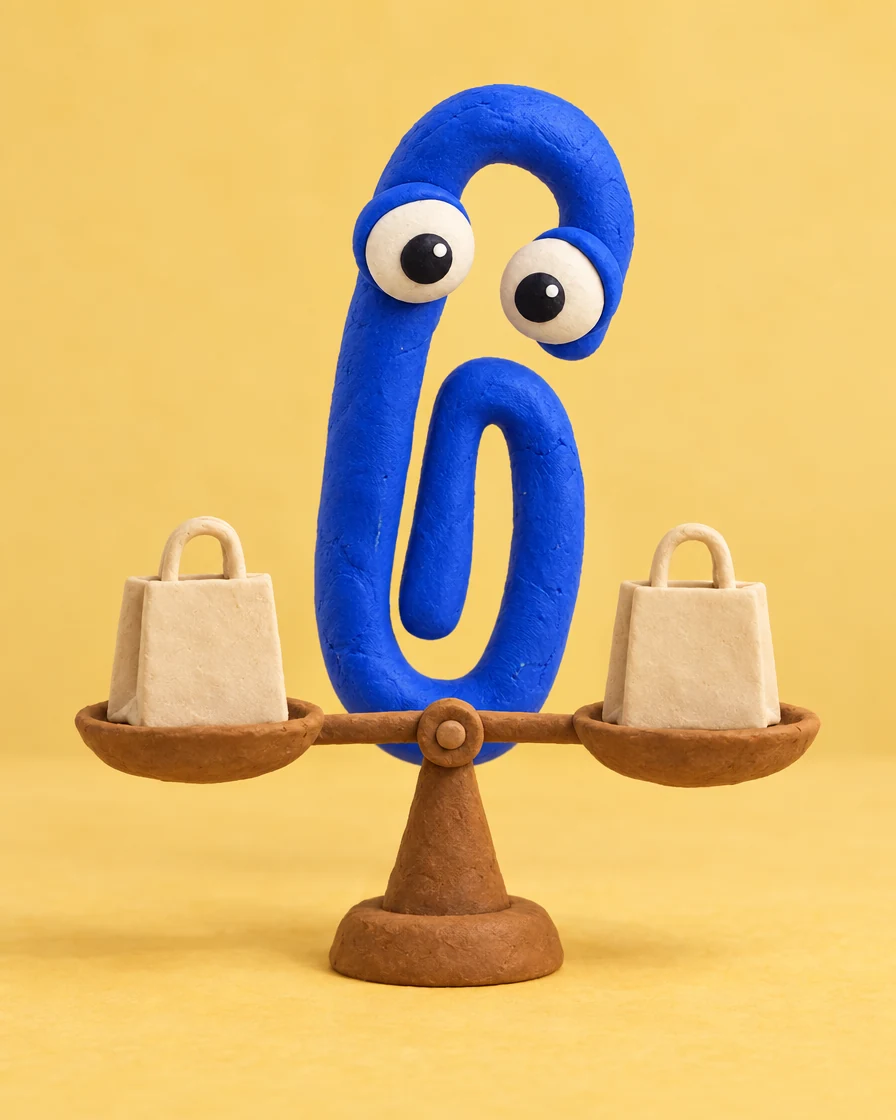
Is a tie-breaker that can favor Clippy still a nudge? A small one, and we'd rather say so than pretend otherwise. That's why it only applies to real ties, it's written into Clippy's public instructions where anyone can read it, and the affiliate disclosure spells out what compensation can and can't affect.
What Clippy won't do
- Make up codes. Clippy only passes along codes from its built-in coupon library. When a store has no code right now, your assistant says "No Clippy codes found." If the library can't be reached, it says the lookup was unavailable instead of claiming no coupons exist.
- Promise a code works. Checkout has the final say. Your assistant compares the final total with and without a code and keeps the code only if the total drops.
- Buy anything. A coupon check never approves a purchase. You and your assistant's settings stay in charge.
- Lurk on store pages. Clippy isn't a browser extension. It's a set of instructions your assistant reads when you shop.
- Collect your cart. To look up codes, your assistant sends Clippy only the store name and currency. Items, prices and totals stay with you.
The honest limits
- Big library, with gaps. Clippy's built-in coupon library has 5,000+ codes across 1,500+ stores, as of Oct 2, 2026. Codes come from affiliate networks and a licensed coupon data partner, and some stores have no current code on a given day.
- It runs on instructions. The tie-breaker and the disclosure are rules your assistant is told to follow. We publish them so you can check, but how well they're followed depends on your assistant.
- Amazon, Walmart and Target aren't included. If you mostly shop at those three, Clippy won't help much there right now.
How to add Clippy
Clippy works in Muse, ChatGPT, Claude and Grok Bot. In Muse, Meta's personal AI assistant, paste this into a chat:
Please add Clippy Mc Clipface as a skill using the setup steps at https://getclippy.co/i?s=blog. When it's saved, ask me the setup questions. From now on, check Clippy for coupons before you pick a store or check out for me.
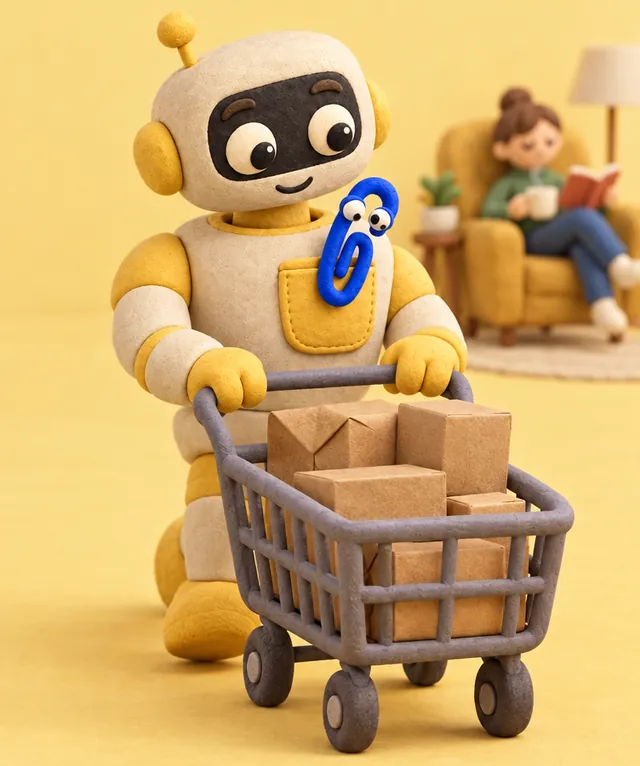
Muse saves Clippy and asks whether you want Community mode or Private mode. Community mode shares a small anonymous note about whether a code worked, so duds sink. Private mode shares nothing, and Clippy still checks for codes either way. No account needed.
In ChatGPT, Claude or Grok Bot, give your AI this link and it adds Clippy: getclippy.co/i?s=blog.
FAQ
Does using a Clippy link cost me more?
Clippy doesn't add anything to your price. The store sets its own prices, shipping and taxes.
Do I have to use the tracked link?
No. You can go to the store yourself or type in the code by hand.
Will Clippy push me toward a store that pays it?
Only to break a real tie. If another store is meaningfully better on price, delivery, returns or reliability, your assistant is told to recommend that store.
Where do Clippy's codes come from?
From Clippy's built-in coupon library, which comes from affiliate networks and a licensed coupon data partner: 5,000+ codes across 1,500+ stores, as of Oct 2, 2026. Clippy doesn't scrape coupon sites or guess codes.
Does Clippy buy things for me?
No. Clippy only checks for codes. You approve every purchase.
Who do I ask about the affiliate setup?
Email clippy@getclippy.co, or read the full affiliate disclosure.
Every little saving adds up, and so does a little honesty. 📎